Notes on music & practice
How to Count Rests in Orchestra: Practice Your Entrances Alone
Count multi-measure rests accurately with worked 4/4 and 3/4 examples, rehearsal cues, and a simple exercise for practicing ensemble entrances alone.

To count several measures of rest, track two things at once: which resting measure you are in and the beats inside it. In 4/4, one common method is to count “1–2–3–4, 2–2–3–4, 3–2–3–4,” changing the first number for each new measure. Keep listening to the ensemble and watching the conductor; counting and musical cues support each other.
A long rest is part of your part. If you skip directly to the next note every time you practice alone, you miss the work of arriving at that note on time. This guide shows how to include the waiting in your preparation.
First, separate beats from measures
A rest inside a measure tells you how long to remain silent at that point. A multi-measure rest represents a number of complete measures. The number above a multi-measure rest is a measure count, not a beat count.
Before counting, check:
- The time signature and the pulse being used.
- Whether you are starting at a barline or partway through a measure.
- How many complete resting measures follow.
- Which beat contains your next entrance.
An eight-measure rest does not necessarily mean “count to eight and play.” In 4/4 with a quarter-note pulse, it contains eight groups of four beats. Your entrance may then come on beat one of the next measure—or later, if more rests are written there.
Worked example: four measures of rest in 4/4
Suppose your part rests for measures 21–24 and enters on beat one of measure 25. Count each resting measure with four beats:
| Written measure | Spoken practice count | Action |
|---|---|---|
| 21 | 1 – 2 – 3 – 4 | First full measure of rest |
| 22 | 2 – 2 – 3 – 4 | Second measure of rest |
| 23 | 3 – 2 – 3 – 4 | Third measure of rest |
| 24 | 4 – 2 – 3 – 4 | Fourth measure of rest |
| 25 | 1 – 2 – 3 – 4 | Play the entrance on beat one |
The bold first number tracks the resting measure. The remaining numbers track beats within that measure. Do not add an extra beat after “4–2–3–4.” The next pulse is the beginning of measure 25.
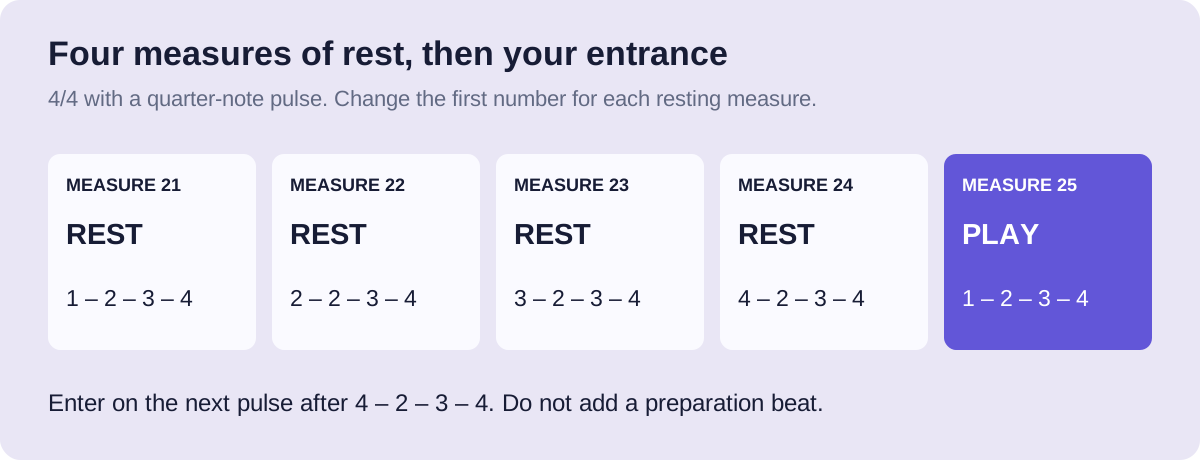
Start by speaking the count with a steady pulse. Then count internally while tapping the entrance. Finally, play the actual entrance on your instrument. Treat each stage as a separate check rather than trying to solve counting and playing simultaneously.
What changes in 3/4 or 6/8?
In 3/4 with a quarter-note pulse, there are three beats per measure. For four complete measures of rest, count:
1–2–3 | 2–2–3 | 3–2–3 | 4–2–3
Then enter on the appropriate beat of the next measure. Do not keep a fourth beat merely because you practiced the previous exercise in 4/4.
In 6/8, the musical pulse is often felt as two dotted-quarter beats, each divided into three eighth notes. At a slower stage, counting all six eighth notes may be useful. In rehearsal, follow the agreed pulse and conductor’s pattern rather than assuming six separate conducting beats. Ask your teacher or conductor which counting approach fits that passage.
If the meter changes during a rest, account for the change at the correct barline. The earlier four-beat pattern no longer applies automatically.
Use cues as a second source of information
A cue is a recognizable musical event near your entrance: perhaps a cello figure, an oboe phrase, or a clear rhythmic change. Listen to a rehearsal recording or follow the full score to identify one you can actually hear.
Write a brief reminder in your own part where permitted, such as “after cello phrase,” along with the correct location. Avoid guessing an instrument from an unclear recording; verify it in rehearsal.
Flutist Patricia George’s discussion of preparing a complete part emphasizes knowing the surrounding music and preparing rests, not only the notes assigned to your instrument. That wider awareness is useful when a count becomes uncertain. The Complete Part, The Instrumentalist.
A cue can change in a live performance, especially if another player makes a mistake. Keep your count, listen broadly, and look up for the conductor instead of relying on one sound alone.
Practice an ensemble entrance when you are alone
Choose an entrance preceded by a manageable stretch of rest. You need your part and a way to maintain or hear the musical pulse: a metronome, a suitable recording, or compatible score playback.
Pass 1: count without playing
Begin at a clearly identified measure before the rest. Count through the silent measures and speak “in” at the entrance. If you lose your place, stop and find where the count changed. Repeating from an uncertain location makes it hard to diagnose the mistake.
Pass 2: prepare the first sound
Repeat the count and get ready for the entrance without changing its timing. A wind player needs time to prepare a breath; a string player needs the bow and left hand ready. Work out that preparation with your teacher rather than waiting until the entrance beat to organize everything.
Pass 3: play past the entrance
Play the entrance and continue for a phrase. This checks whether you can move from counting to making music without interrupting the pulse. Later, begin farther back so the cue is part of a longer musical sequence.
Solfena can play a compatible MusicXML ensemble score while you follow your selected part. Include the resting measures in the playback range; starting playback on your first note removes the counting task. Its current practice tools do not assess whether your live entrance was correct.
Troubleshoot an early or late entrance
| Problem | What to check |
|---|---|
| You enter one measure early | Did you treat the final resting measure as the entrance measure? |
| You enter one beat late | Did you add a preparation beat after the rest ended? |
| You lose count after a meter change | Did you continue using the old number of beats? |
| A recording and your part disagree | Are the edition, repeat structure, and starting point the same? |
| You count correctly but still miss the entrance | Can you prepare the first note while keeping the pulse? |
When working with a repeat, make sure you know which pass you are hearing. Rehearsal letters, measure numbers, and a confirmed cue can help you locate the same musical moment in different practice attempts.
What if I lose count during rehearsal?
Look to the conductor and listen for a location you can identify confidently. Follow your ensemble’s rehearsal conventions rather than making a loud guess. Afterward, ask about the location and add a useful reminder for next time.
Should I count aloud in the orchestra?
Counting aloud can help during individual preparation. In rehearsal or performance, count silently unless the conductor is specifically leading a spoken-counting exercise.
Can I loop the rest and entrance together?
Yes. Include a clear starting point, the rest, and the first part of your phrase. Pause if the repeated return becomes confusing. Our practice-loop guide explains how to choose boundaries, and the MusicXML guide explains how to prepare a score for playback.