Notes on music & practice
How to Loop Difficult Measures for Better Music Practice
Build useful practice loops around difficult measures. Learn where to start and stop, choose a tempo, and reconnect the passage to the full piece.

To practice a difficult measure, choose one clear problem, select a short passage that includes it, and play at a tempo where you can notice what happens. After working on the detail, practice entering and leaving the passage. A loop is a tool for directing attention; repeating it many times is not, by itself, evidence that the problem is solved.
This approach works with a printed score and a metronome, or with a score-based practice app. The example below uses an imaginary passage in 4/4 so you can adapt it to piano, guitar, strings, or winds without needing a particular piece.
Start with a question you can answer
“Measure 12 is difficult” is a starting observation. A more useful question identifies something you can hear or see:
- Does the last eighth note arrive late?
- Is the change into the next chord interrupting the pulse?
- Do you release the note before its full written length?
- Are you unsure which note comes after the rest?
Choose one question for the next few attempts. If you try to judge pitch, rhythm, tone, fingering, and phrasing all at once, it can be hard to tell what changed.
Paul Harris’s practice discussion for ABRSM encourages learners to consider what a short session is intended to achieve. Use that idea to set a specific observation rather than an arbitrary repetition target. ABRSM practice guidance.
Choose loop boundaries that match the problem
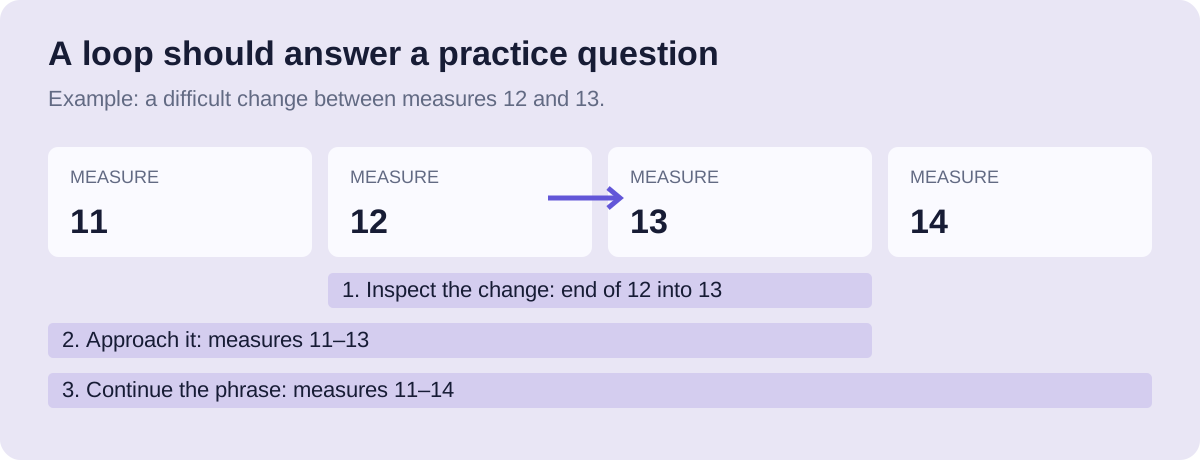
Imagine measures 11–14 contain a difficult change from the end of measure 12 into measure 13. There are three different jobs you might give the passage:
| Practice job | What to play | What to listen for |
|---|---|---|
| Understand the notes | The end of measure 12 and beginning of 13 | Correct order and rhythm at the change |
| Approach the change | Measures 11–13 | Arriving at the difficult spot without hesitation |
| Continue the phrase | Measures 11–14 | Keeping the pulse after the change |
These are example boundaries, not a rule that every problem requires four measures. If the trouble is a single rhythm, start smaller. If the difficulty is remembering an entrance after silence, include the silence.
An app may select only complete measures. You can still pause and work on a smaller figure with your instrument before returning to the playback range.
Choose a tempo for observation, not a target to beat
Use a speed that gives you time to notice the particular issue. For an unfamiliar rhythm, that may mean counting and tapping before using the instrument. For a movement problem, it may mean discussing the fingering, bowing, or coordination with a teacher.
Slow practice and small tempo increases are longstanding teaching tools. David Littrell’s Kansas State University practice notes describe both working at a manageable speed and focusing on limited portions of a passage. Ideas on Practicing.
As a concrete example, suppose the passage is marked quarter note = 96. Try 60 as an initial experiment—not a prescribed percentage. If you cannot keep the rhythm there, simplify further. If 60 makes an already familiar movement awkwardly disconnected, another tempo may be more informative.
Keep the score’s beat unit in mind. A number alone is ambiguous: quarter note = 60 and dotted quarter note = 60 describe different pulses.
Use a repeat–pause–describe cycle
Play the selected passage once or twice, then stop and describe what happened in a short sentence. For example: “The change was accurate, but I shortened the note before it.” That sentence tells you what to try next.
If every attempt breaks down at the same place, change something meaningful: inspect the notes, narrow the range, count the rhythm, or ask for help. Continuing the same unsuccessful attempt at the same speed gives you little new information.
You can leave automatic looping on while working, but it is also fine to pause between repetitions. Continuous playback is not a requirement for effective passage practice.
A ten-minute session you can adapt
This schedule is an example, not a claim about how quickly someone should learn a piece.
| Time | Activity | A useful result |
|---|---|---|
| Minutes 0–2 | Read and listen to measures 11–14 | Name the exact transition or rhythm to investigate |
| Minutes 2–5 | Work on the short problem area | Describe what improves and what remains uncertain |
| Minutes 5–7 | Begin earlier and play through the change | Find out whether the approach creates a new difficulty |
| Minutes 7–9 | Continue into measure 14 without stopping | Hear whether the phrase remains connected |
| Minute 9–10 | Note the passage, tempo, and next question | Leave a clear starting point for your next session |
Take additional breaks whenever you need them. If playing causes discomfort, stop and address it rather than treating discomfort as a sign of useful effort.
Decide when to increase the tempo
Before moving the metronome, ask whether the passage is accurate, steady, and physically comfortable enough to repeat deliberately. One successful attempt after several failures is worth noticing, but it does not tell the whole story.
Try a small increase and compare the result. There is no universal number of repetitions or BPM increment that suits every player and piece. If the new speed changes the problem, return to a workable speed or reconsider the exercise.
Later, begin from a different point and try the passage without several immediate warm-up repetitions. This gives you another observation: can you find the passage when the lead-in is less familiar?
Bring the passage back into the piece
The final part of loop practice is turning the loop off. Play a longer phrase that crosses both boundaries. Check the connection at the entrance, the difficult detail, and the continuation.
Keep diagnostic practice and uninterrupted playing as distinct activities. During diagnosis, stopping to investigate is useful. During a run-through, note what needs work and return to it afterward when practical. The aim is to learn the music as a connected phrase, not to make stopping at the same measure part of the performance.
Using score playback in Solfena
Solfena lets you select a passage, adjust playback tempo, and repeat it. Use the count-in if it helps you establish the pulse. A compatible ensemble score can also provide musical context around your part.
Its coach can explain notes and rhythm from the selected score, but it does not hear or grade your playing. Use your own listening and a teacher’s guidance to evaluate the result.
Need a playable file first? Read MusicXML vs PDF for iPad practice. If the difficult moment is an entrance after silence, try counting rests while practicing alone.
How long should a practice loop be?
Long enough to contain the question you are working on, and short enough that you can identify what happened. A transition may need notes on both sides of a barline; a full phrase needs more context.
Should I always play along with the loop?
No. Listening, counting, and playing are different tasks. Try one pass listening without the instrument, one pass counting the rhythm, and then a pass playing when you know what you intend to do.